 DeepAssemblyIOBIO Lab
DeepAssembly server information
Overview of multi-domain protein and protein complex assembly
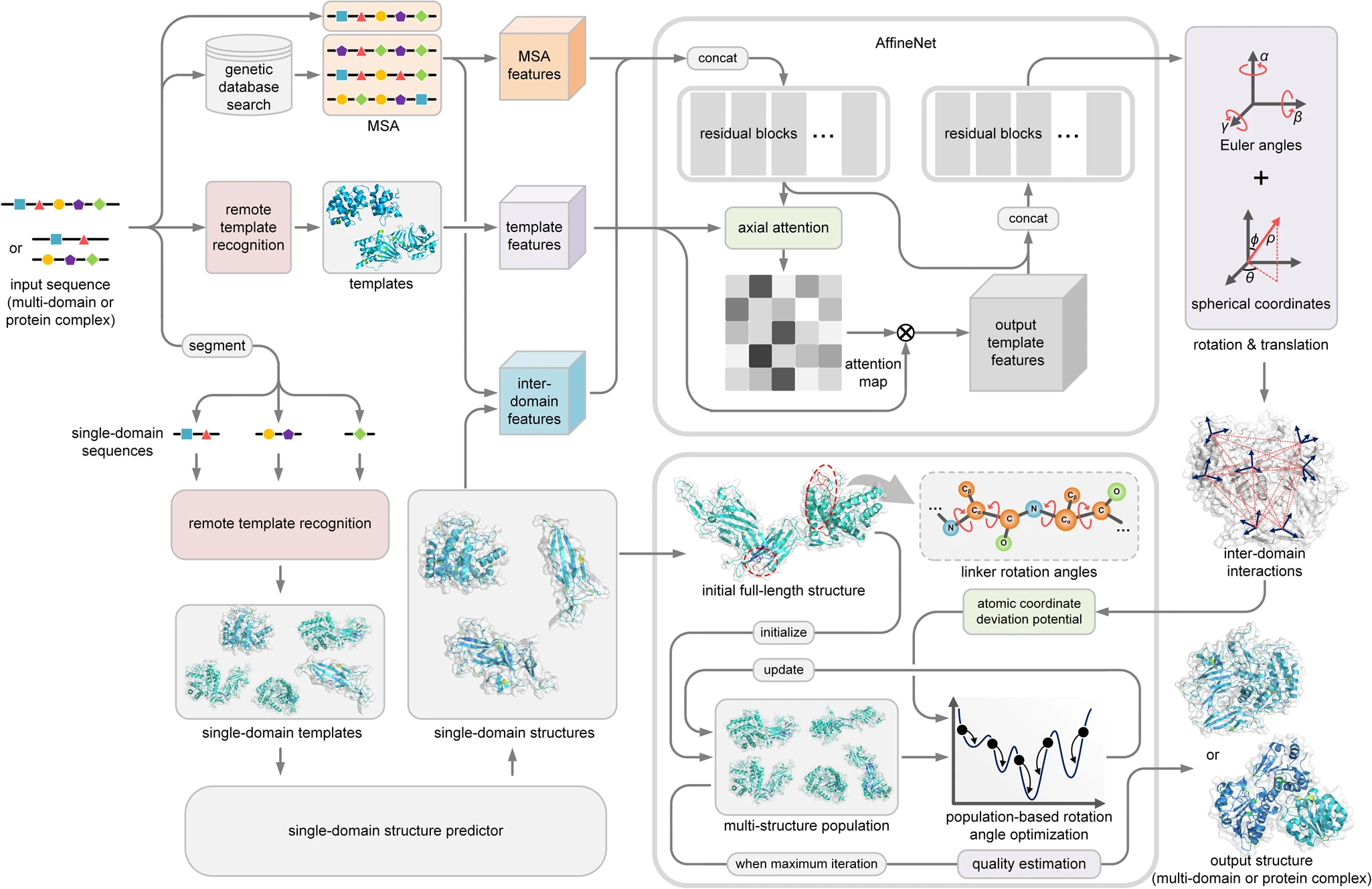
DeepAssembly is designed to automatically construct multi-domain protein or complex structure through inter-domain interactions from deep learning. Starting from the input sequence of multi-domain protein (or protein complex), DeepAssembly first generates MSAs from genetic databases and searches for templates using our in-house PAthreader. Meanwhile, the input sequence is split into single-domain sequences by a domain boundary predictor, and then the structure for each domain is generated by single-domain structure predictor. Subsequently, features extracted from MSAs, templates and domain boundary information are fed into a deep neural network with self-attention to predict rotations, translations between inter-domain residues, and convert them into inter-domain interactions. Finally, DeepAssembly performs the creation of the initial full-length structure using the single-domain structures, followed by multiple steps of iterative population-based rotation angle optimization and atomic-level structure refinements. The domain assembly simulation is driven by the atomic coordinate deviation potential transformed from predicted inter-domain interactions, where the best conformation by our in-house model quality assessment is selected as the final output structure.
Overview of antibody-antigen complex assembly
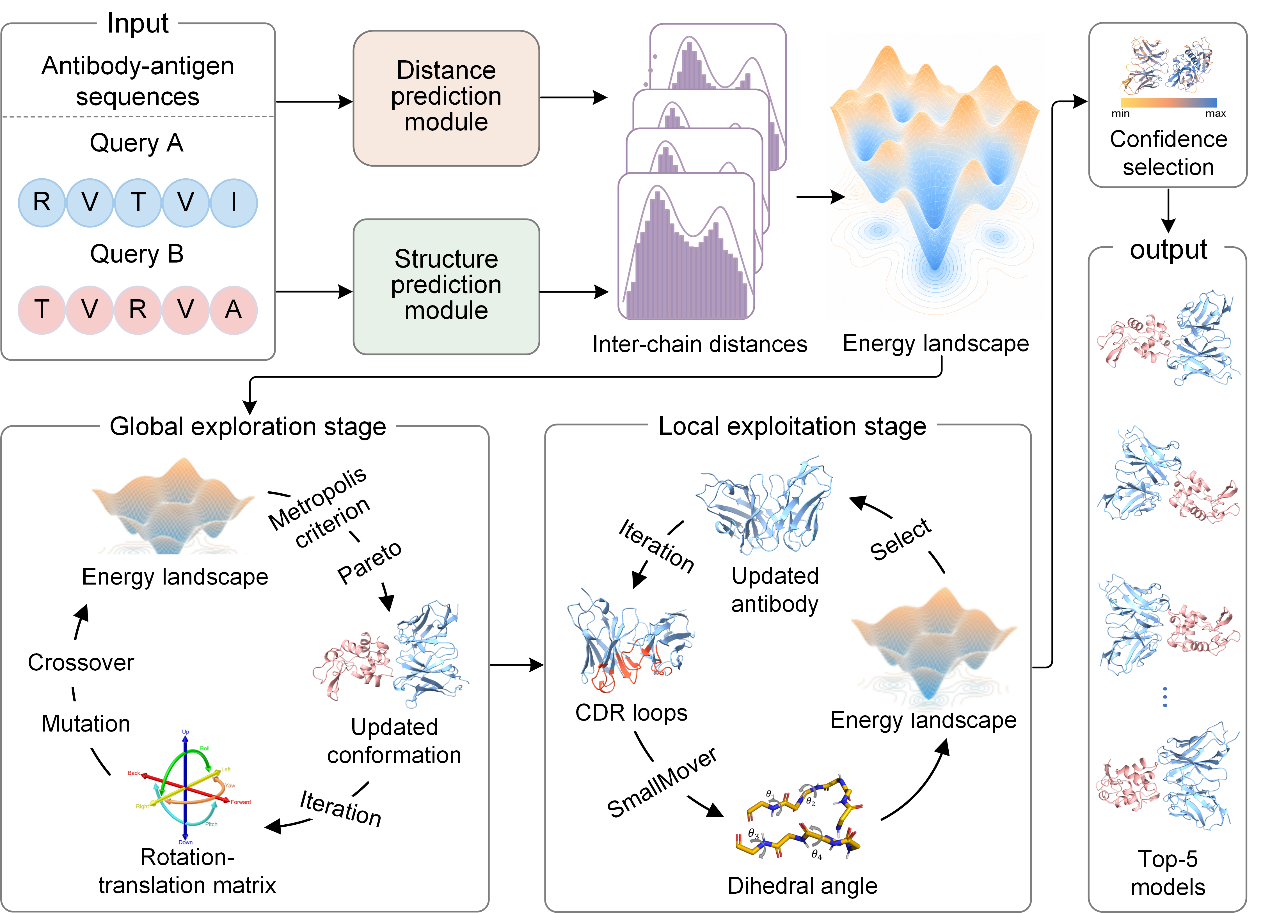
DeepAssembly-AA is a computational protocol specifically designed for antibody-antigen complex structure modeling. This protocol integrates deep learning-based inter-chain residue distance prediction with a Monte Carlo conformational sampling method to generate accurate binding conformations. Specifically, the predicted distance maps are employed as knowledge-based energy constraints to guide sampling toward physically plausible configurations. To efficiently explore the conformational space, we designed a two-stage exploration-exploitation strategy. In the exploration stage, diverse binding orientations are extensively sampled under the guidance of the energy landscape. In the subsequent exploitation stage, refinement is performed on the complementarity-determining region loops to enhance geometric and energetic complementarity at the interface. Finally, the sampled conformations are evaluated through an energy-guided confidence selection mechanism, from which the optimal conformation is identified as the final output.
Performance of DeepAssembly in the structure modeling blind test of CASP16
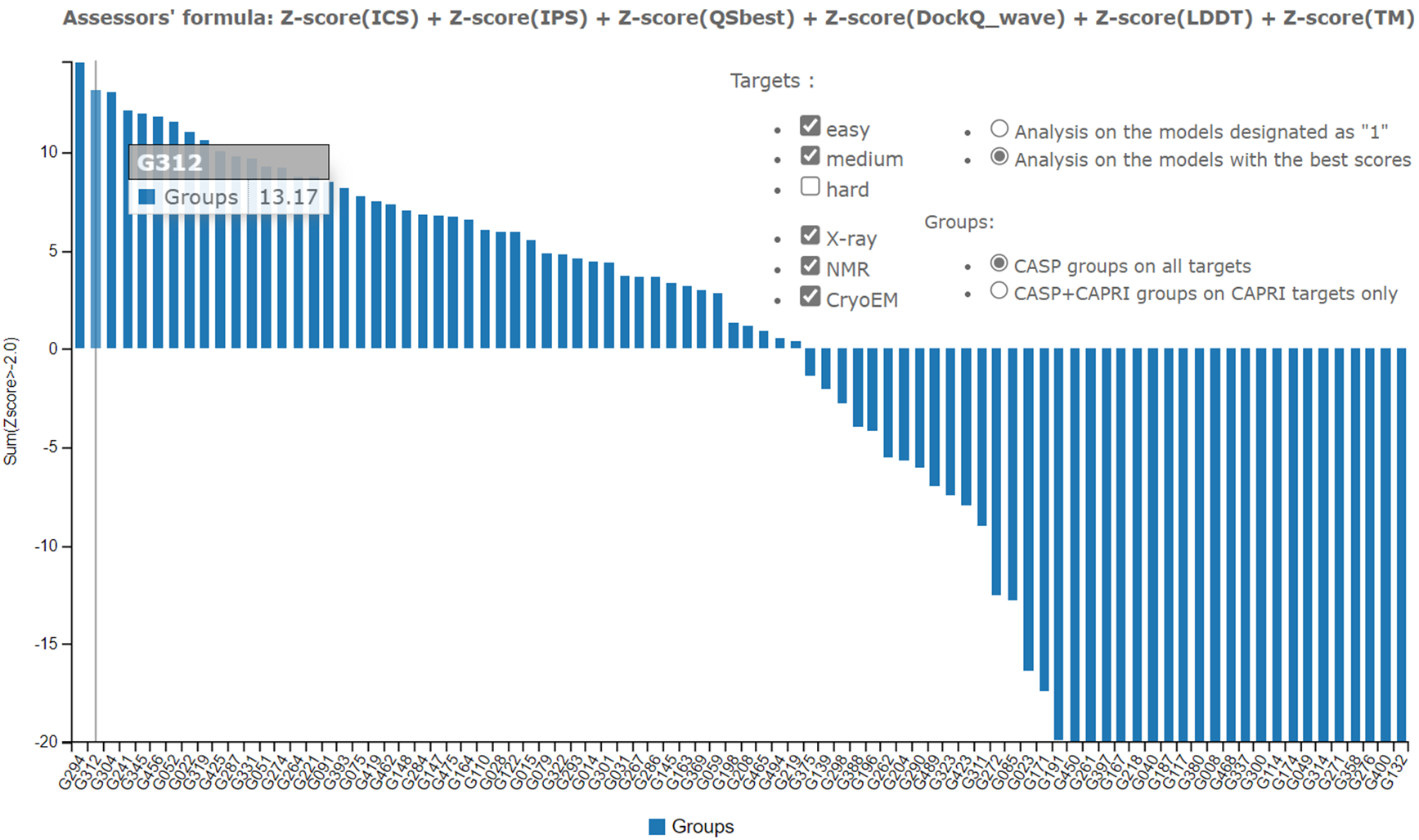
In the CASP16 blind assessment of protein complex structure modeling, DeepAssembly (group name: GuijunLab-Assembly) ranked second in modeling easy and medium targets. The results are available at https://predictioncenter.org/casp16/zscores_multimer.cgi.

Performance of DeepAssembly in the CAMEO blind test
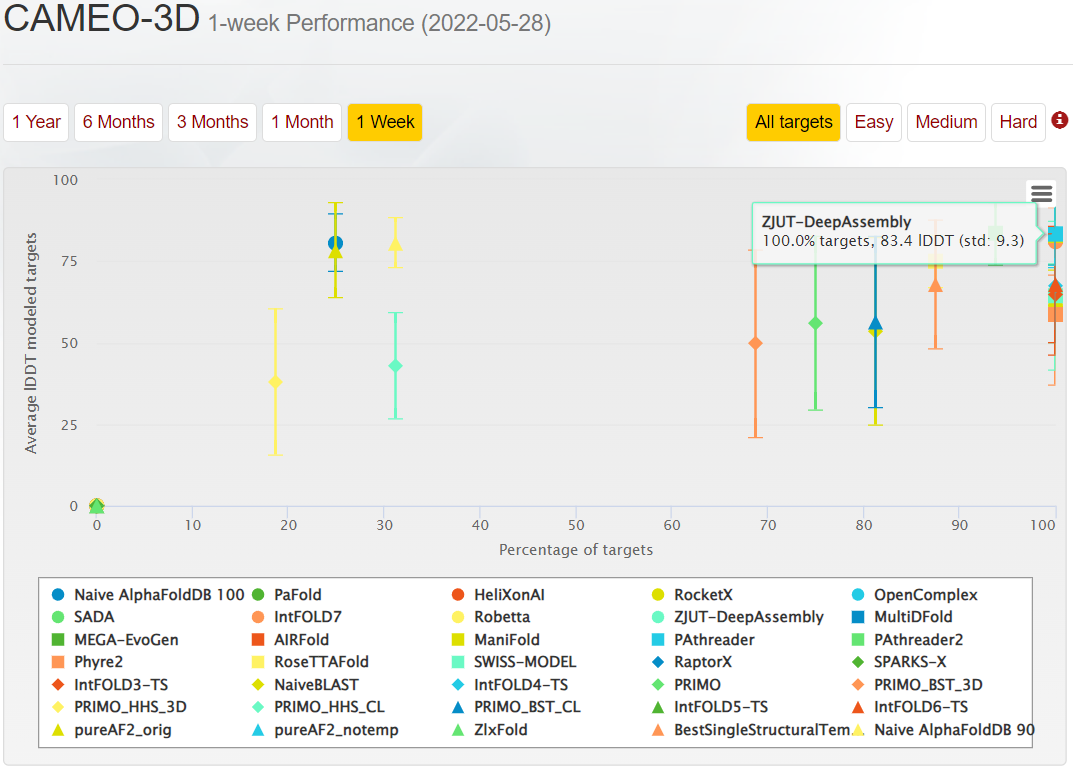
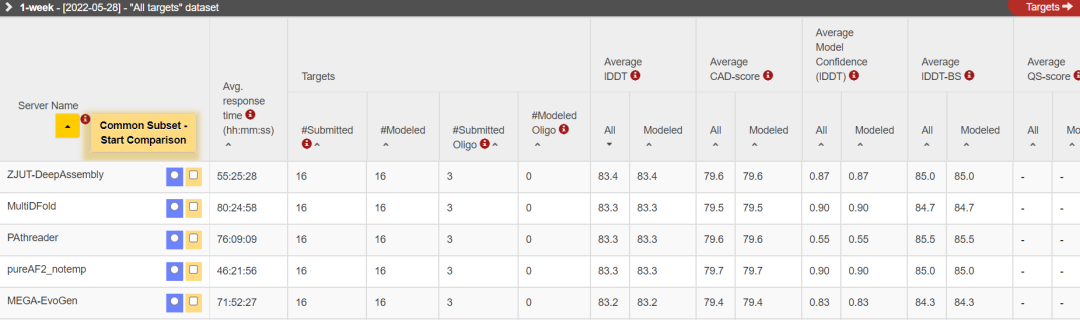
In the CAMEO blind test for protein structure modeling, DeepAssembly (group name: ZJUT-DeepAssembly) ranked first in the one-week evaluation on May 28, 2022. The results are available at https://www.cameo3d.org/modeling/.
How to cite DeepAssembly?
Please cite the following articles when you use the DeepAssembly server:
- Yuhao Xia✝, Kailong Zhao✝, Dong Liu, Xiaogen Zhou, Guijun Zhang*. Multi-domain and complex protein structure prediction using inter-domain interactions from deep learning. Communications Biology, 6, 1221 (2023). DOI: https://doi.org/10.1038/s42003-023-05610-7
- Yuhao Xia, Yilin Pu, Suhui Wang, Jianan Zhuang, Dong Liu, Minghua Hou, Guijun Zhang*. DeepAssembly2: A web server for protein complex structure assembly based on domain-domain interactions. Journal of Molecular Biology, 437, 169128 (2025). DOI: https://doi.org/10.1016/j.jmb.2025.169128
- Suhui Wang✝, Jianan Zhuang✝, Xinyue Cui, Zexin Lv, Dongliang Hou, Guijun Zhang*. High-accuracy structural modeling of antibody-antigen complexes. Communications Biology, (2026). DOI: https://doi.org/10.1038/s42003-026-10757-0